An air conditioner that runs constantly is not always failing. On the hottest afternoons of a Central Kentucky summer, a correctly sized system is supposed to run almost without stopping. The real fault is usually somewhere else: restricted airflow, a dirty outdoor coil, low refrigerant, leaking ducts, or humidity the equipment is never given long enough to remove.
The complaint sounds simple. The unit is running, the thermostat is set to 72, and the house still feels warm, or sticky, or both. What makes it hard to diagnose is that two completely different problems produce the same sentence. One is a temperature problem. The other is a moisture problem. They have different causes and different fixes, and most advice on the subject treats them as the same thing.
This walks through both, in the order a homeowner can actually check them.
First, decide whether it is even a fault
Residential cooling equipment is not sized to hold a house at 72 degrees no matter what happens outside. It is sized to a specific outdoor condition, and that condition is deliberately close to the worst of the year.
The design figure the industry uses is the 1 percent cooling design temperature. NOAA’s National Centers for Environmental Information define it as a value that “has been exceeded only 1% of the time during the entire” period of record. ENERGY STAR requires that basis for equipment selection, stating that “the EPA recommends that designers always use the ACCA Manual J, 8th edition, 1% cooling season design temperature and 99% heating season design temperature.”
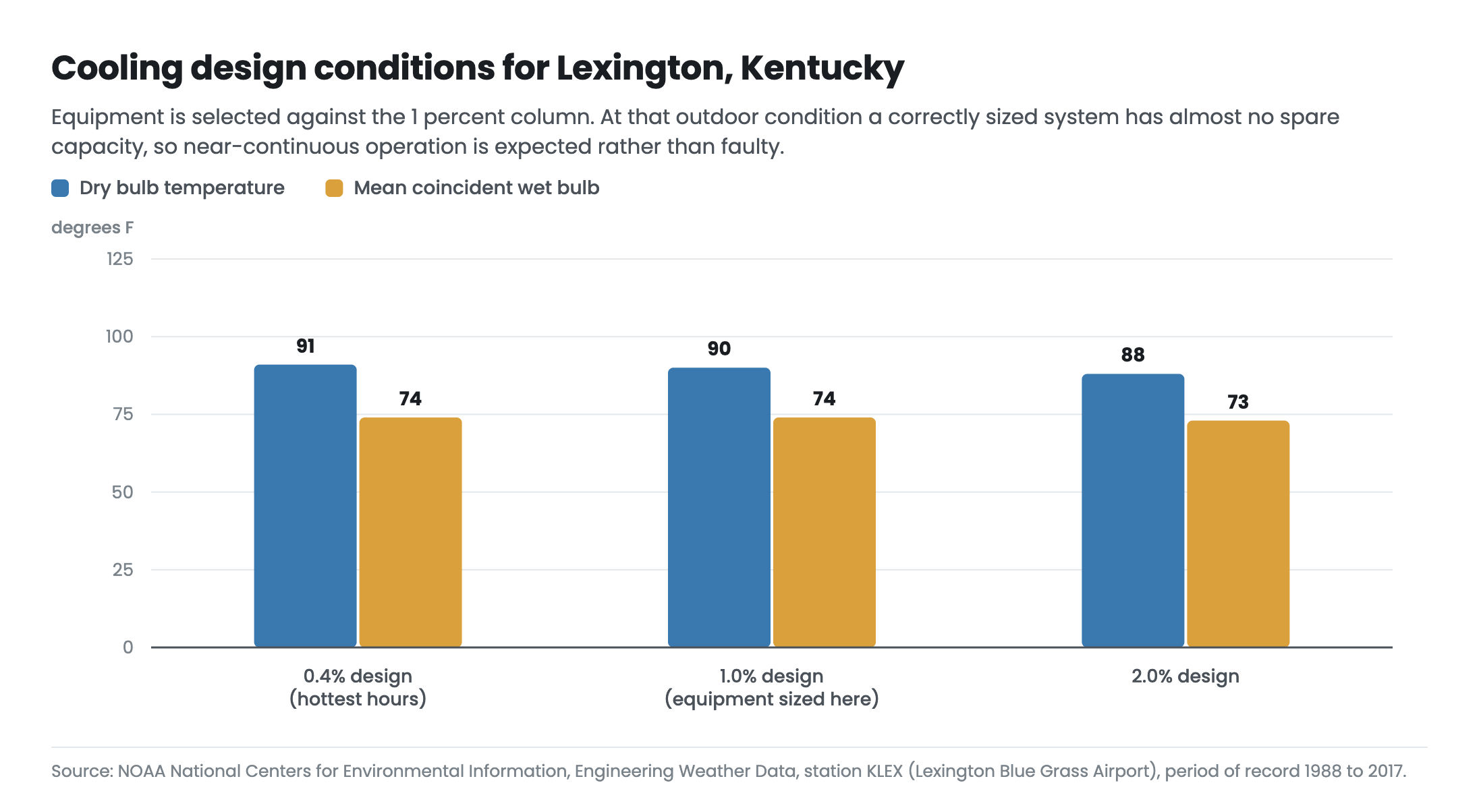
For Lexington Blue Grass Airport, the nearest first-order weather station to most of Central Kentucky, NOAA gives a 1 percent cooling design condition of 90 degrees dry bulb with a 74 degree mean coincident wet bulb, over the 1988 to 2017 period of record.
Now add the sizing rule. The Department of Energy’s Building America program specifies that “cooling equipment capacity not exceed the total load by more than 15%,” and its Solution Center puts the acceptable window at 95 to 115 percent of the calculated design load.
Put those two together and the conclusion follows. A correctly sized air conditioner has almost no spare capacity on a design-day afternoon. Running continuously on the hottest afternoon in August is the equipment doing exactly what it was selected to do. That is not a symptom.
Continuous running becomes a symptom when it happens on a mild day, when the indoor temperature climbs while the system runs, or when the house cools to setpoint but still feels damp.
A temperature problem and a moisture problem are not the same complaint
This is the distinction that decides most of these calls, and it is the one almost never explained.
An air conditioner does two jobs at once. It removes heat, which lowers the temperature. That is the sensible load. It also condenses water vapor out of the air on the cold indoor coil, which lowers the humidity. That is the latent load. ENERGY STAR defines them plainly: sensible cooling load is the energy “added to home that increase temp,” latent cooling load is the energy “added to home that increase humidity.”
In Central Kentucky the latent half is large. NOAA’s design data for Lexington records a 1 percent humidity ratio of 140 grains of moisture per pound of dry air in mid-July, with a mean maximum around 113 to 116 grains. The National Weather Service office in Louisville, which covers most of this region, describes Ohio Valley summers as having “dewpoints during the summer range from the middle 60s to middle 70s,” and places dew points in the 70s in the “quite uncomfortable (very humid)” band.
The practical consequence: a system can be removing the right number of BTUs and the house can still feel wrong, because the moisture is not coming off the coil. The EPA recommends keeping “indoor relative humidity below 60 percent indoors, and ideally between 30-50 percent,” and adds that “while air conditioning use can reduce humidity, if indoor humidity is consistently above 60%, then a specific dehumidification strategy should be employed.”
A cheap hygrometer settles the question in an afternoon. If the thermostat reads 72 and the room still feels heavy, read the humidity before assuming the compressor is failing.
What a homeowner can check in ten minutes
Four of these need no tools and no training. Work through them before calling anyone.
The air filter
Start here, because it is the most common cause and the cheapest fix. The Department of Energy states that “replacing a dirty, clogged filter with a clean one can lower your air conditioner’s energy consumption by 5% to 15%,” and recommends cleaning or replacing filters “every month or two during the cooling season.”
The mechanism matters more than the percentage. Restricting airflow does not just waste energy, it strips cooling capacity. DOE’s Building America measure guideline reports that at 250 cubic feet per minute per ton, well below the 350 to 400 target, “sensible capacity falls to 75%, total capacity to 85%, and EER is reduced to about 92%.” The same document found that “about two-thirds of the homes studied by Wilcox had airflow rates lower than the minimum recommended value of 350 cfm per ton,” and that airflow “near or below 200 cfm per ton” can ice the indoor coil.
A frozen coil is worth naming, because it is the one case where the answer is counterintuitive. Ice on the indoor coil or the copper line means the system should be switched off and allowed to thaw. Continuing to run it makes the situation worse, not better.
The outdoor unit
The outdoor coil has to reject heat to the air around it. If it cannot, nothing else works. DOE notes that “outdoor condenser coils can also become very dirty if the outdoor environment is dusty or if there is foliage nearby,” and names the usual culprits: “your dryer vents, falling leaves, and lawn mower are all potential sources of dirt and debris.”
The clearance figure is specific. DOE recommends trimming foliage back “at least 2 feet” around the unit. Cottonwood season, grass clippings blown into the fins, and a shrub planted a little too close are all ordinary and all worth two minutes of looking.
The thermostat fan setting
This one causes more humidity complaints than its profile suggests, and it costs nothing to fix.
ENERGY STAR’s guidance is blunt: “set fan mode to ‘AUTO’ not ‘ON’.” With the fan set to ON it runs continuously, including after the compressor stops. Air then keeps moving across an indoor coil that is still wet, and the water that was just condensed out of the house evaporates straight back into it. DOE’s Building America Solution Center recommends setting the fan time delay “to 30 seconds or less” in humid climates precisely “to prevent moisture on the evaporator coil from evaporating back into the air stream and contributing to indoor humidity.”
If the fan is on ON and the house feels clammy, switch it to AUTO and give it a day.
Registers, returns and the condensate drain
Closed or blocked supply registers, furniture pushed against a return, and a clogged condensate drain all produce symptoms that look like equipment failure. DOE notes simply that “clogged drain channels prevent a unit from reducing humidity.”
What needs a technician
Past that point the diagnosis needs gauges and training. Three causes account for most of it.
Refrigerant charge
Refrigerant is not consumed the way fuel is. It circulates in a sealed loop, so a system that is low has a leak. The EPA is direct about the right response: “if your air conditioner leaks, ask your service technicians to locate and repair the leak instead of ‘topping it off’,” and notes that “repairing leaks will keep your system operating at its best, while reducing refrigerant emissions and energy use.”
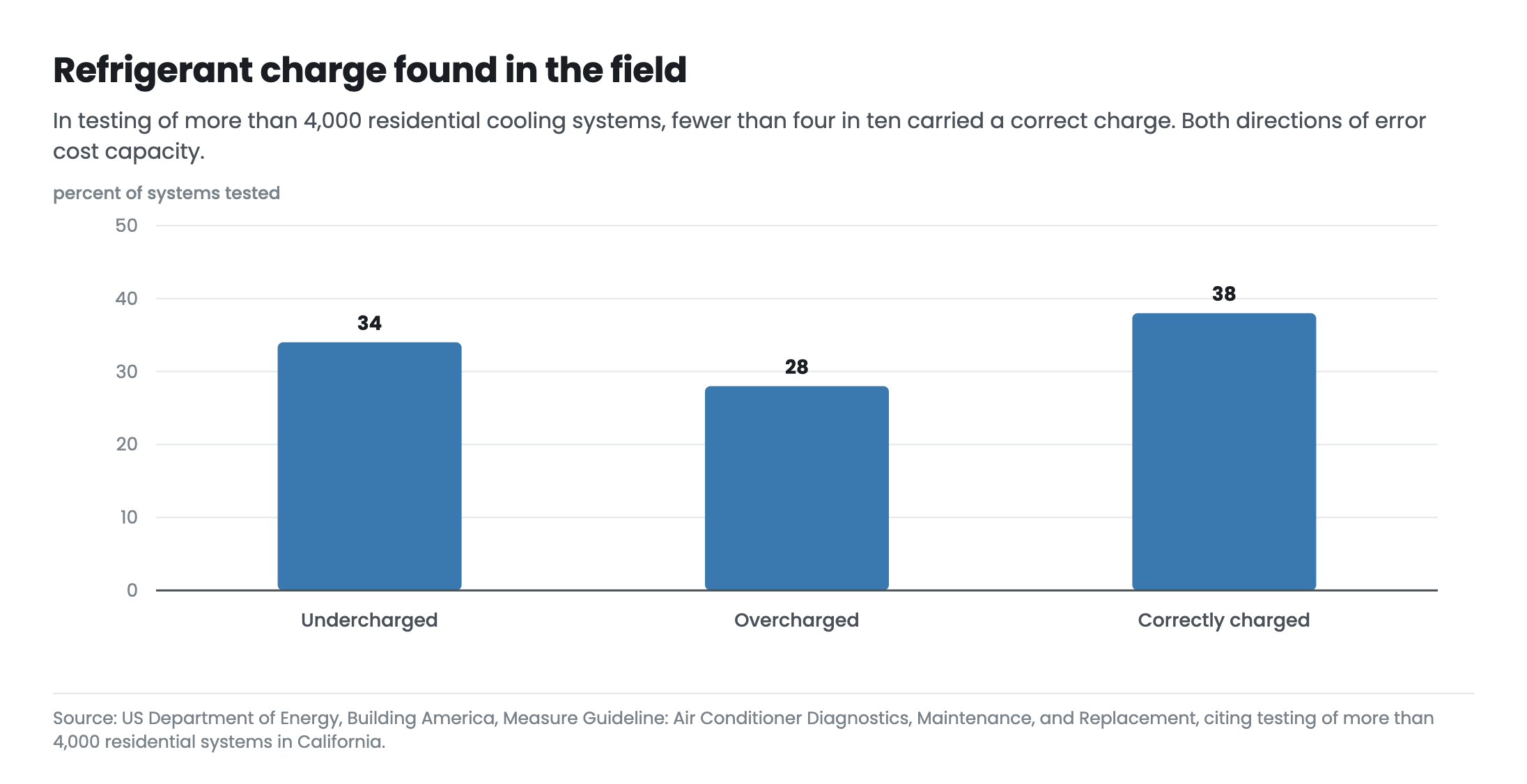
Charge error is also more common than most people expect. DOE cites testing of more than 4,000 residential cooling systems in California in which “about 34% were undercharged, 28% were overcharged, and only 38% had the correct charge.” An undercharged system can also ice up, because “the low suction line pressure and corresponding saturation temperature of the refrigerant can lead to ice formation on the evaporator.”
Duct leakage
Air that never reaches a room cannot cool it. ENERGY STAR’s figure for a typical house is that “about 20 to 30 percent of the air that moves through the duct system is lost due to leaks, holes, and poorly connected ducts,” and that sealing and insulating ducts “can improve the efficiency of your heating and cooling system by as much as 20 percent.”
Ductwork running through an unconditioned attic is the worst case, because the air it loses is lost at the exact moment the attic is hottest. Sealing leaks and repairing damaged runs is a different job from cleaning ducts, and it is the one that changes performance.
Failing electrical components
Worn contactors, capacitors and compressor controls produce their own patterns. DOE lists among its replacement indicators that “your compressor and fan controls could be worn out from having your system turn off and on too frequently.” A unit whose outdoor fan spins but whose compressor does not, or one that hums without starting, is an electrical diagnosis and not a homeowner job. The air conditioning repair page covers what that visit involves.
Oversized or undersized: the fork that decides everything
Most articles list “wrong size unit” as a single bullet. That collapses two opposite problems into one, and the symptoms point in opposite directions.
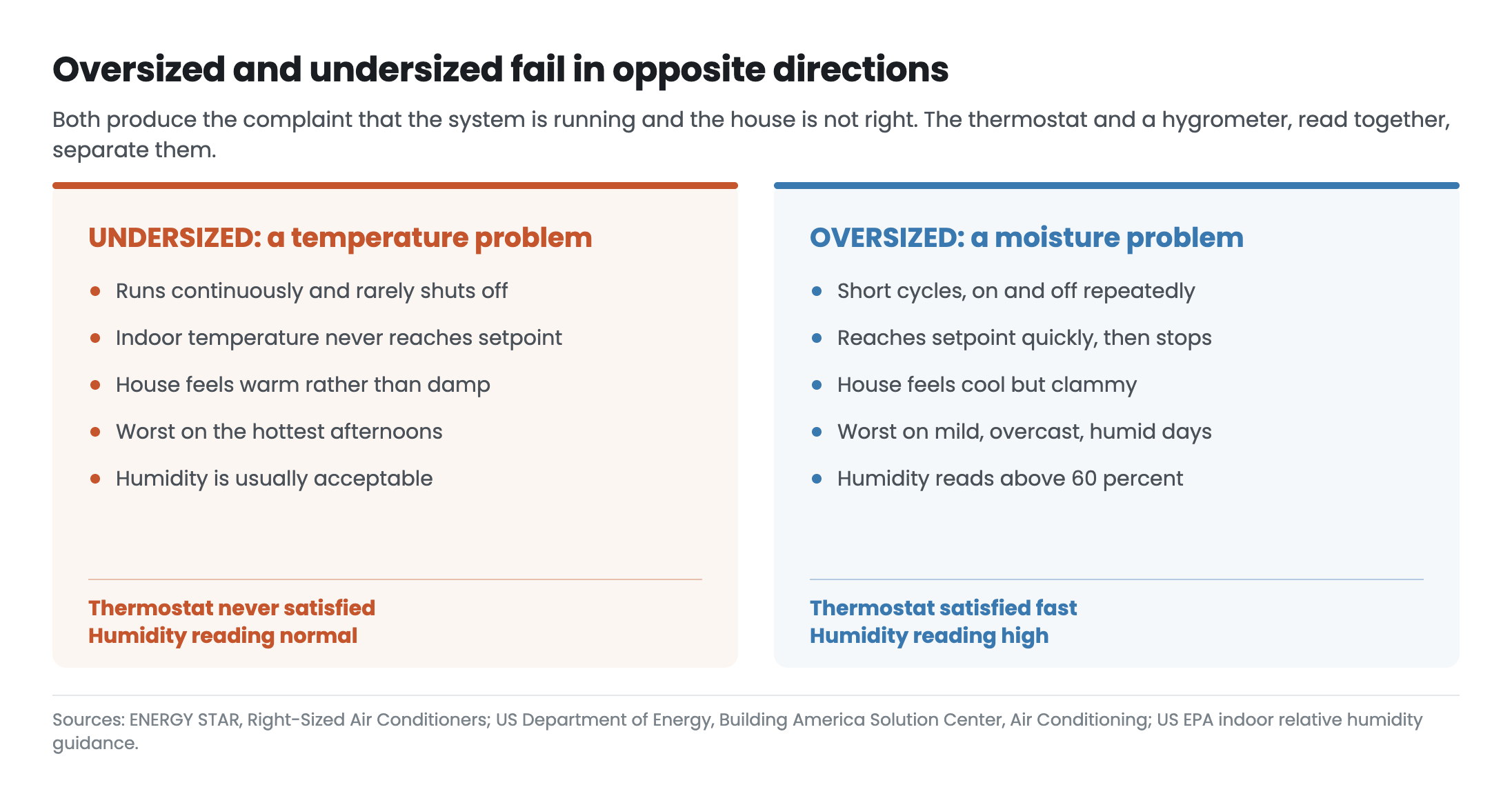
An undersized system runs constantly and the temperature never comes down. There is not enough capacity to meet the load, so the thermostat is never satisfied. The house is warm and the unit never rests.
An oversized system does the reverse. ENERGY STAR describes it precisely: oversized units “short-cycle, or run for shorter periods of time than engineered for optimum operation,” and “bursts of cold air from oversized units can trick the thermostats into shutting off.” The consequence is the sticky house. “Short operation times do not allow the system to effectively remove humidity,” and “short-cycling reduces the amount of condensation that drains off the coils.” DOE’s Solution Center puts it in one sentence: an oversized system “will turn on and bring the air temperature down below the thermostat set point quickly then shut off before the system has had time to remove moisture from the air.”
Efficiency also has a wrinkle here that runs against intuition. ENERGY STAR notes that “efficient homes tend to decrease sensible load, but not latent load as much,” and that a higher efficiency unit can carry a higher sensible heat ratio, meaning it dedicates less of its capacity to moisture removal. A newer, tighter house with a higher-rated system can be more prone to a humidity complaint, not less.
Short cycling also costs efficiency outright. ENERGY STAR reports that “the efficiency of air conditioners is low when they first start and increases gradually, reaching peak efficiency in about 10 minutes,” and that “when operating time increases from 5 to 9 minutes, efficiency improves 17 percent.”
The Central Kentucky pattern that catches people out
There is a detail in NOAA’s own engineering guidance that explains a complaint pattern almost nobody writes about. NOAA warns that the moisture level occurring alongside the hottest hour is not the worst moisture of the year: “the mean coincident value for humidity at the 0.4% peak dry bulb temperature is not the highest moisture value, and must not be used for design of humidity control systems,” because “the highest moisture values typically occur when the dry bulb temperatures are lower.”
In plain terms, the muggiest hours in Kentucky are not the hottest hours. They are the overcast, rained-on, mid-80s afternoons in July and August. On those days there is less sensible load, so the system runs shorter cycles, and shorter cycles remove less moisture, at exactly the moment there is more moisture to remove.
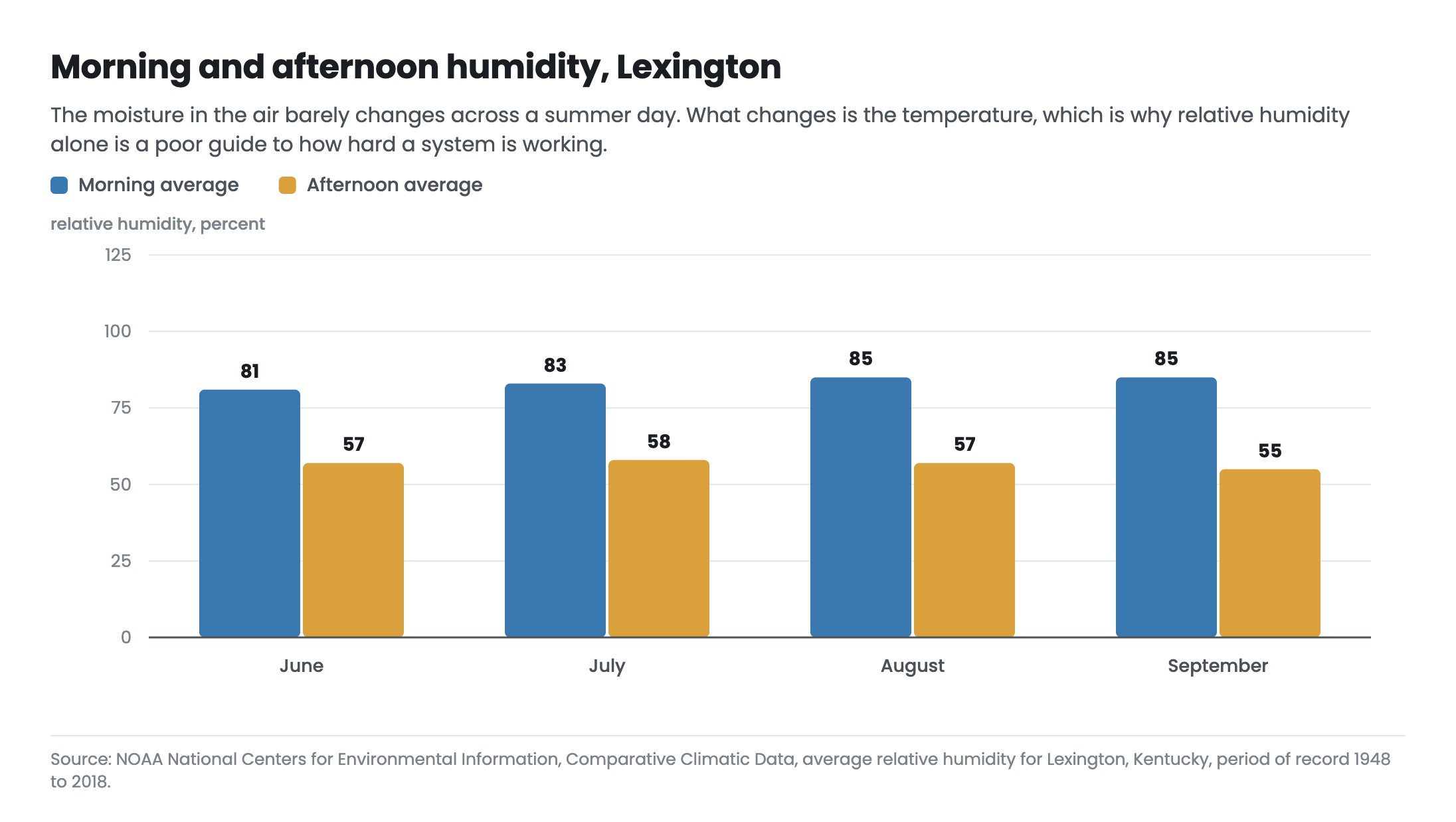
The relative humidity normals for Lexington show the same effect from another angle. In July the average morning relative humidity is 83 percent and the average afternoon figure is 58 percent. The moisture in the air barely changes across the day. What changes is the temperature. The National Weather Service explains why relative humidity misleads here: “while dewpoint gives one a quick idea of moisture content in the air, relative humidity does not since the humidity is relative to the air temperature.”
Common questions
Is it normal for an AC to run 20 hours a day?
On the hottest days of the year, long run times are expected, because equipment is sized to the 1 percent design condition and carries at most 15 percent spare capacity above the calculated load. What is not expected is long run times on a mild day, or run times that grow across a season while the weather stays the same.
How do you stop an air conditioner from running constantly?
In order: replace the filter, clear two feet around the outdoor unit, set the thermostat fan to AUTO rather than ON, and open blocked registers and returns. If it still runs without reaching setpoint after those four, the likely causes are refrigerant charge, duct leakage or a failing component, and all three need a technician.
Why is the AC not shutting off after reaching the set temperature?
If the temperature is reached and the fan keeps blowing, the thermostat fan is almost certainly set to ON instead of AUTO. If the compressor itself keeps running past setpoint, that points at a thermostat calibration or wiring fault.
Should the AC be switched off if it is not cooling?
If there is visible ice on the indoor coil or the refrigerant line, yes, switch it off and let it thaw before running it again. If a burning smell or repeated breaker trips are involved, switch it off and leave it off. Otherwise it can usually keep running while the checks above are worked through.
Why is the house cool but still humid?
That combination points at short cycling rather than a capacity shortfall, most often from an oversized system, a fan left on ON, or both. The EPA’s guidance is that indoor relative humidity consistently above 60 percent calls for a dedicated dehumidification strategy rather than simply more cooling.
Getting it looked at
Southern Heating & Cooling is a veteran owned, family operated HVAC company based in Junction City, and we work on residential systems across Central Kentucky. If the filter, the outdoor unit, the fan setting and the registers have all been checked and the house still is not right, that is the point where a diagnostic visit earns its keep. We can look at charge, airflow, duct losses and the electrical side in one call, and tell you plainly which of the causes above is actually the one.
You can book a visit online, get in touch here, or read what a seasonal maintenance visit covers if you would rather get ahead of next summer. For a system that will not cool at all in the middle of a heat wave, there is emergency service. If the diagnosis turns out to be an aging system rather than a repair, the AC installation and replacement page explains how sizing is handled, and payment options covers financing.
We serve Danville, Junction City, Nicholasville, Harrodsburg, Stanford, Springfield, Richmond and Liberty. The full service area, the rest of our services, our FAQs and who we are are all worth a look. Winter has its own version of this problem, covered on the heating repair page.
Sources
- US Department of Energy, Energy Saver: Maintaining Your Air Conditioner
- US Department of Energy, Building America: Measure Guideline, Air Conditioner Diagnostics, Maintenance, and Replacement
- US Department of Energy, Building America: Strategy Guideline, HVAC Equipment Sizing
- US Department of Energy, Building America Solution Center: Air Conditioning
- ENERGY STAR: Right-Sized Air Conditioners
- ENERGY STAR: Duct Sealing
- ENERGY STAR: Design Temperature Limits for Residential New Construction
- US EPA: Biological Contaminants and Indoor Air Quality
- US EPA: Homeowners and Consumers Frequently Asked Questions
- NOAA NCEI: Engineering Weather Data, Lexington Blue Grass Airport
- NOAA NCEI: Comparative Climatic Data, Average Relative Humidity
- National Weather Service Louisville: Discussion on Humidity