The clearest signal that an air conditioner is near the end is age combined with a pattern, not any single breakdown. ENERGY STAR treats a heat pump or air conditioner “more than 10 years old” as the point to start evaluating replacement, while the Department of Energy puts the typical service life of a central system at 15 to 20 years. What has changed for 2026 is the refrigerant underneath the decision.
Most articles on this subject give a list of symptoms and a dollar rule. The symptom list is broadly right. The dollar rule, as it turns out, comes from nowhere in particular. What actually deserves attention this year is that the equipment being sold as a replacement is no longer the same platform that was sold five years ago, and almost nobody has told homeowners that.
Age is the first filter, not the verdict
Two published figures matter here and they are often conflated.
ENERGY STAR’s replacement guidance lists, as its first criterion, “your heat pump or air conditioner is more than 10 years old.” That is a trigger to evaluate, not a declaration that the equipment is finished. The Department of Energy’s own figure for expected life is longer: room air conditioners at 10 to 15 years, central air conditioning and mini-split systems at 15 to 20 years.
Both are true and they answer different questions. Ten years is when it becomes worth running the numbers, because efficiency gains since installation may now be large enough to matter. Fifteen to twenty is when failure becomes likely rather than possible. A twelve year old system in good condition is not on borrowed time. A twelve year old system that has needed two significant repairs is a different conversation.
DOE’s Building America program also names specific condenser replacement indicators, which are more useful than a general age rule: a system more than 15 years old, a system oversized for the load, a condenser coil that is “damaged (fins compressed or corroded),” and “compressor amps are higher than rated and/or the compressor is noisy or failing.”
What ENERGY STAR actually lists as replacement signals
It is worth quoting the published list rather than a paraphrase of it, because the real one contains items most articles leave out and omits some they include.
ENERGY STAR’s criteria for considering replacement are that the heat pump or air conditioner is more than 10 years old, the furnace or boiler is more than 15 years old, the equipment “needs frequent repairs and your energy bills are going up,” some rooms “are too hot or too cold,” nobody is home for long periods without a programmable thermostat, the home “has humidity problems,” the home “has excessive dust,” the system “is noisy,” and the household’s score on the ENERGY STAR Home Energy Yardstick is below five.
Two things about that list are worth pointing out honestly.
First, frequent repairs and rising bills are a single combined criterion, not two. Either one alone means less than the pair together. A system that needed one expensive repair but whose running costs have not moved is a weaker case for replacement than the symptom lists suggest.
Second, and more usefully, ENERGY STAR itself attributes several of these to causes other than a dying unit. Its cooling checklist notes that rooms which are too hot or too cold may come from “improper operation, duct problems, or insufficient insulation,” and that a noisy cooling system “could indicate an undersized duct system or indoor coil problems.” Uneven cooling and noise are diagnostic branch points, not death certificates. Replacing a compressor because the ductwork is undersized changes the equipment and not the complaint.
Duct losses are large enough to be worth ruling out first. DOE puts air loss through ducts at “about 30 percent of a cooling system’s energy consumption.”
The refrigerant question, which has changed twice since 2020
This is the part that has moved, and it is the reason a repair-or-replace decision in 2026 is not the same decision it was in 2021.
R-22, and what is actually prohibited
Systems installed before roughly 2010 generally run on R-22. The common claim is that R-22 is banned and those systems must be replaced. That is not what the rule says, and the EPA is explicit about it.
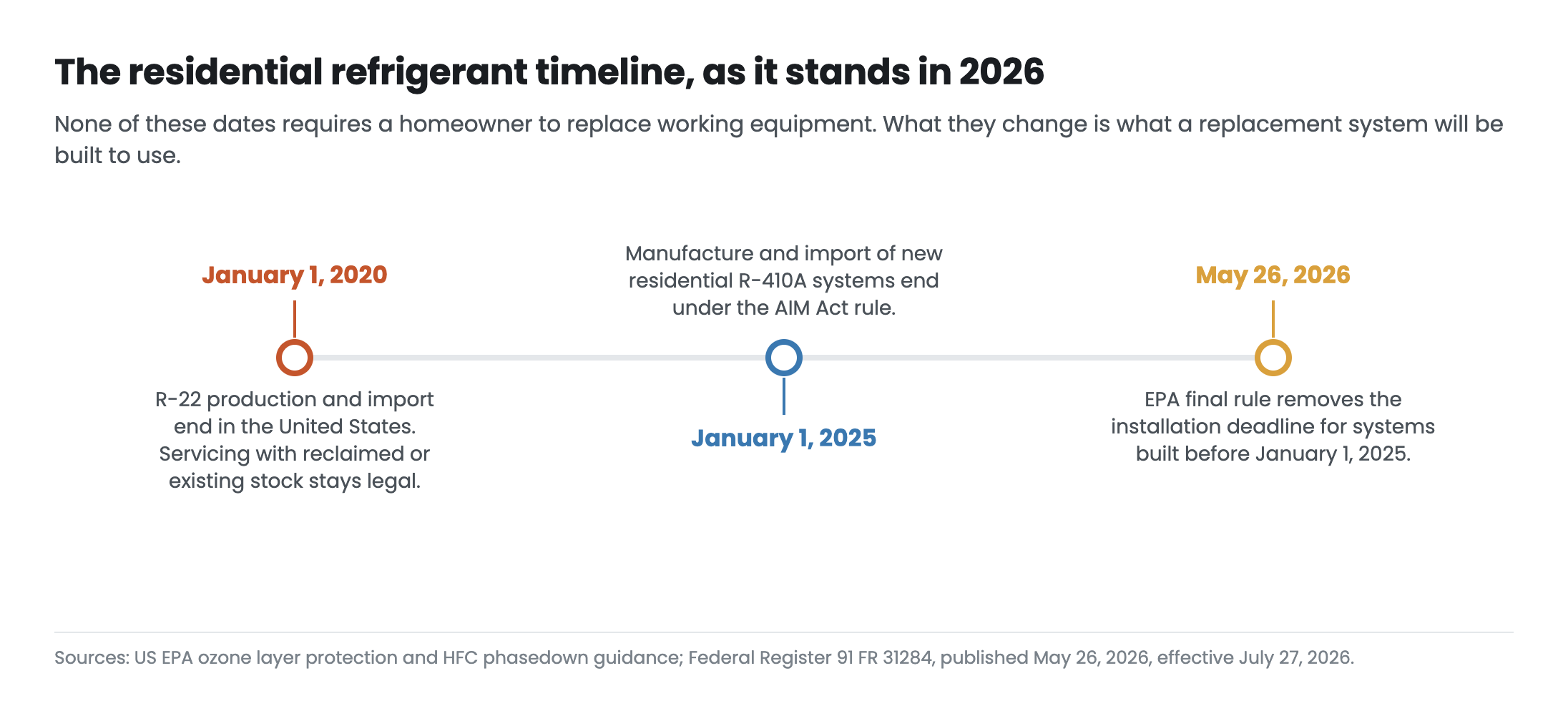
Production and import ended on a fixed date: “as of January 1, 2020, no new HCFC-22 will be made or imported into the United States.” Everything after that is about supply, not legality. The EPA states that “people can continue to use air-conditioning (AC) equipment that uses HCFC-22,” that “EPA does not require homeowners to replace their existing equipment,” and that “there is no EPA requirement to get a new system or convert existing HCFC-22 units for use with a non-ozone-depleting substitute refrigerant.”
Servicing remains legal indefinitely: “after 2020, only recycled, reclaimed, or previously produced HCFC-22 can be used to service existing equipment,” and EPA notes that technicians repairing leaks “will most often continue to charge HCFC-22 into the system as part of that repair.”
So the honest position is this. An R-22 system is not illegal and does not have to be replaced. But it is drawing on a supply that is no longer being made, and the age signal is the stronger argument anyway: a system still running R-22 is at minimum around sixteen years old, which puts it at the top of DOE’s 15 to 20 year service life range on its own.
R-410A and the AIM Act, which is the 2026 story
The newer systems, the ones installed roughly 2010 to 2024, run on R-410A. Those are now on their own transition, and the timeline has moved once already.
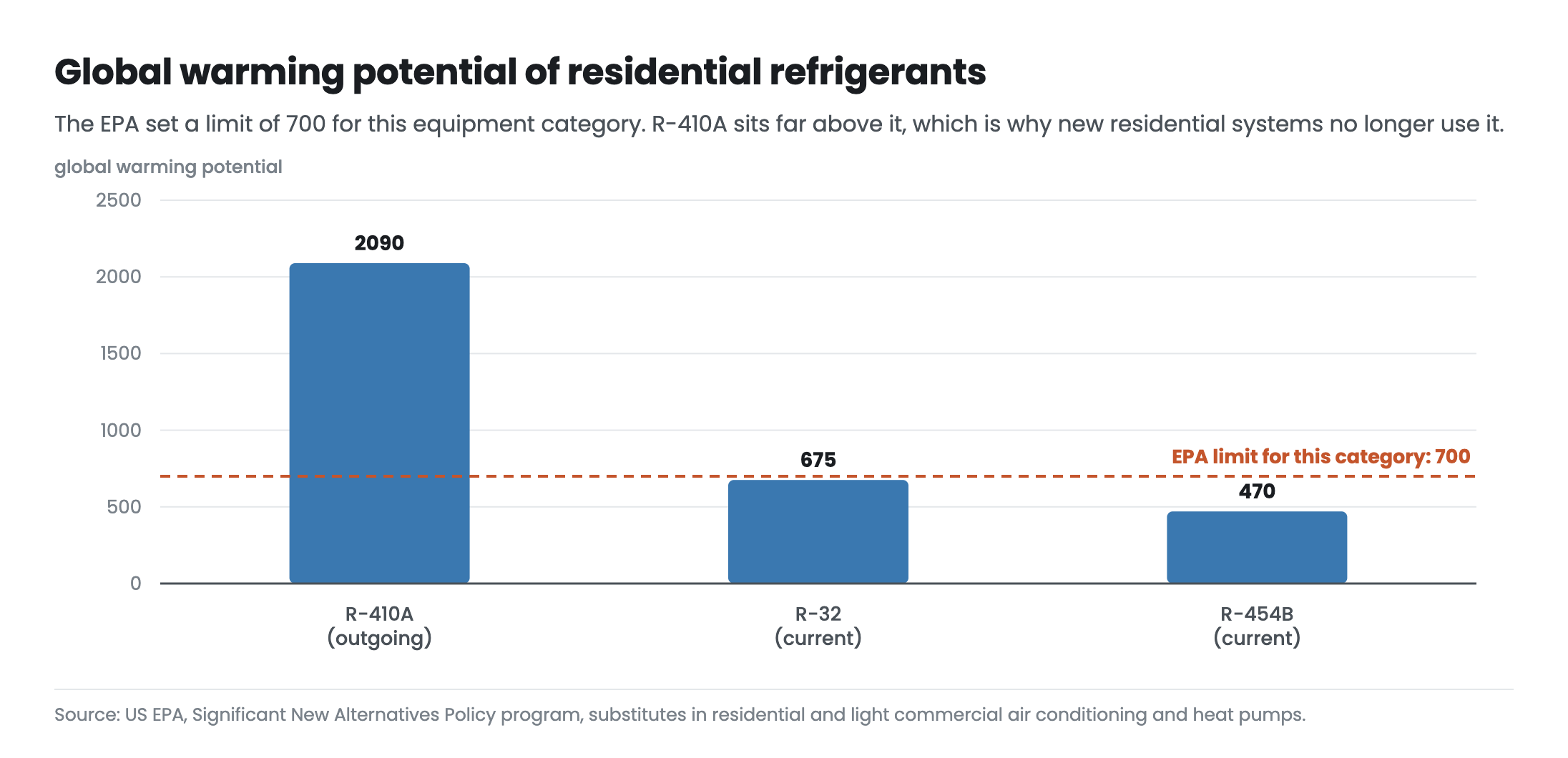
Under the American Innovation and Manufacturing Act, the EPA set a global warming potential limit of 700 for residential and light commercial air conditioning and heat pump equipment, with a compliance date of January 1, 2025. R-410A has a global warming potential of roughly 2,090, so it does not qualify. Manufacture and import of new residential systems using it ended on that date.
Then it changed. An interim rule in December 2023 allowed systems built from pre-2025 components to be installed up to January 1, 2026. A final rule published on May 26, 2026, effective July 27, 2026, went further and “removes the installation deadline for systems in the residential and light commercial air conditioning and heat pumps (AC/HP) subsector, where all specified components of such systems were domestically manufactured or imported before January 1, 2025.” Existing pre-2025 inventory can still be installed.
New equipment uses R-454B or R-32 instead, with global warming potentials of 470 and 675 respectively. Both carry the ASHRAE A2L classification, a lower flammability category, and both are approved for residential use with conditions attached to how they are installed and handled.
What that means for a system bought around 2014
Take the common case: a twelve year old R-410A system facing a significant repair.
Nothing in the rules forces a decision. The EPA states that “there are no requirements to stop using any specific equipment or appliance currently in use,” that consumers “will be able to continue using their equipment until the end of its useful life,” and answers the direct question plainly: “yes, you can continue to repair your existing refrigeration, air conditioning, and heat pump system.” The phasedown “is forward looking and restricts new products and systems from being placed on the market or entering operation.”
What has changed is the nature of the replacement. A homeowner replacing a system now is not buying a newer version of the same thing. They are buying different equipment, on a different refrigerant, with different handling requirements. That does not make a repair the wrong answer. It does mean a major repair on a system already at the top of its age range is a decision worth taking deliberately, rather than defaulting into.
What Kentucky’s efficiency rules actually require
This is a detail with real local consequences and it is almost never stated correctly.
The Department of Energy divides the country into three regions for central air conditioning standards. Kentucky is in the Southeast region, alongside Tennessee, Virginia, North Carolina and the rest of the southern tier. It is not in the North region, which is the assumption a lot of people make.
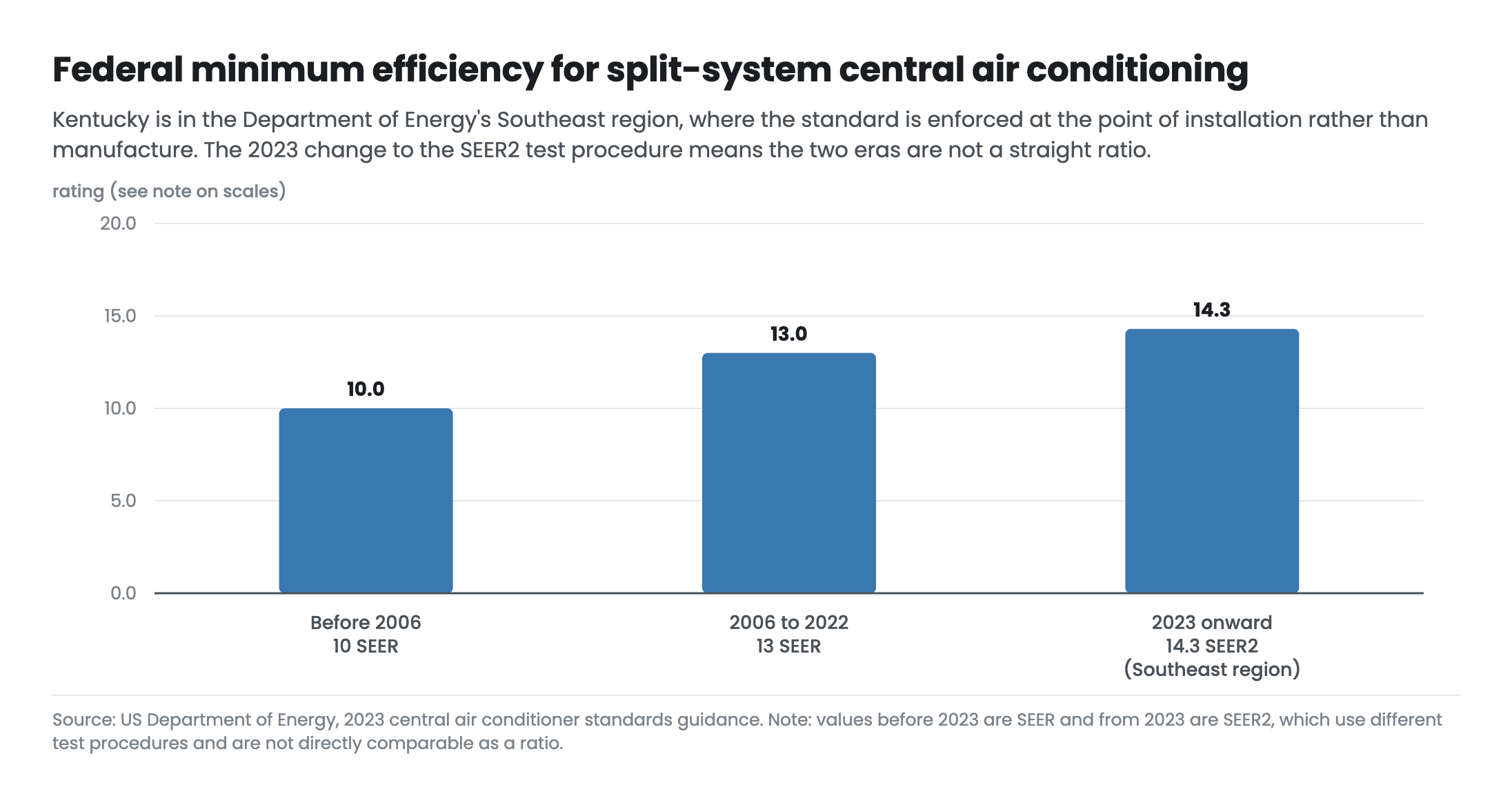
Since January 1, 2023 the minimum for a split-system central air conditioner in the Southeast region has been 14.3 SEER2. Split-system heat pumps sit at 14.3 SEER2 nationwide, with no regional split.
The enforcement mechanism is the part that matters to a Kentucky homeowner. North region standards apply by date of manufacture. Southeast and Southwest standards apply by date of installation. In practical terms, it is not lawful to install a split system below 14.3 SEER2 in Kentucky, regardless of when the unit was built. Leftover lower-efficiency stock that can legally be installed in Ohio cannot legally be installed here.
For scale, the national minimum was 10 SEER before January 2006 and 13 SEER from 2006 until the 2023 transition. A system dating from the 1990s or early 2000s was built to a standard well below what is installed today.
One caution on that comparison, because it is routinely got wrong. SEER and SEER2 are not the same scale. SEER2 uses a revised test procedure with higher external static pressure, so the same equipment carries a slightly lower number under SEER2 than it did under SEER. Comparing a 10 SEER system directly against a 14.3 SEER2 rating overstates the gap. The efficiency improvement is real and it is large. The arithmetic just is not a straight ratio.
Making the decision without a magic number
There is a rule that circulates widely, in which the age of the unit multiplied by the repair cost gives a threshold above which replacement wins. It appears on a great many contractor websites.
It has no authoritative source. No ENERGY STAR, Department of Energy, EPA, ASHRAE or AHRI publication contains it. It is trade folklore that spread through content marketing, and any page presenting it as an industry standard is passing on something it did not check.
The published criteria are a better basis, and they are not arithmetic. Weigh these together rather than individually:
- Age against service life. Past 15 years, the odds shift. Past 10, it is worth pricing the alternative.
- Repairs and running costs together. ENERGY STAR pairs them deliberately. Repeat repairs on a system whose bills are also climbing is the strongest single indicator on the published list.
- Whether the complaint is actually the equipment. Uneven rooms, noise and dust all have duct and insulation explanations. Rule those out before condemning a compressor.
- Which refrigerant it runs. Not because any rule forces the issue, but because an R-22 system is old by definition.
- What a replacement would actually save. ENERGY STAR certified equipment is documented as consuming at least 20 percent less energy than standard models. Against a system built to a 1990s minimum, the gap is wider still.
What to ask before agreeing to a replacement
The installation matters as much as the equipment. ENERGY STAR notes that “improper installation can reduce system efficiency by up to 30 percent,” which is enough to cancel out the entire benefit of moving up an efficiency tier.
Three questions are worth asking of anyone quoting the work.
Was a load calculation done? Sizing should come from an ACCA Manual J calculation on the actual house, not from the size of the old unit. DOE’s guidance is that capacity should fall between 95 and 115 percent of the calculated design load. Replacing like for like carries forward whatever sizing error was there before.
What refrigerant does the proposed system use, and is it new or existing stock? Both answers are legitimate in 2026. It is reasonable to know which one is being installed.
Are the bids comparable? ENERGY STAR publishes a free heating and cooling installation bid comparison sheet for exactly this, and it is worth using. It is a neutral document, not a sales tool.
Common questions
How long should a central air conditioner last?
The Department of Energy gives a typical service life of 15 to 20 years for central air conditioning and mini-split systems, and 10 to 15 years for room units. Maintenance, run hours and installation quality all move that figure in either direction.
Is it illegal to keep an R-22 air conditioner?
No. The EPA states that homeowners are not required to replace existing equipment and that R-22 systems can continue to be used and serviced with reclaimed or previously produced refrigerant. Production and import of new R-22 ended on January 1, 2020, which affects supply rather than legality.
Can an R-410A system still be installed in 2026?
Manufacture and import of new residential R-410A systems ended on January 1, 2025. A final rule published on May 26, 2026 removed the installation deadline for systems whose components were manufactured or imported before that date, so remaining inventory can still be installed. New production has moved to R-454B and R-32.
What efficiency rating is required in Kentucky?
Kentucky is in the Department of Energy’s Southeast region, where the minimum for a split-system central air conditioner has been 14.3 SEER2 since January 1, 2023. In the Southeast region the standard is enforced at the point of installation rather than manufacture.
Is there a rule for when repair costs more than replacement is worth?
No authoritative body publishes one. The widely repeated formula multiplying unit age by repair cost is absent from every federal and standards-body publication on the subject. ENERGY STAR’s own criteria, particularly repeat repairs combined with rising energy bills on equipment past its expected life, are the better basis.
Can a failing system show up as humidity rather than heat?
Yes. ENERGY STAR lists “your home has humidity problems” among its replacement criteria. Humidity complaints also have causes unrelated to equipment age, including oversizing and a thermostat fan left running continuously, so they are worth diagnosing before they are worth replacing.
Where to go from here
Southern Heating & Cooling is a veteran owned, family operated HVAC company working on residential systems across Central Kentucky, and this is a conversation we would rather have honestly than quickly. If a system is fifteen years old and running fine, we will say so. If the real problem is ductwork rather than the condenser, we would rather fix the ductwork.
If something is not right now, start with air conditioning repair, or emergency service if the house is unlivable. If the decision really is about replacement, the AC installation and replacement page covers how sizing and equipment selection are handled, payment options covers financing, and a maintenance plan is what keeps the next system from aging early. Heating has the same arithmetic on a longer clock, covered on the heating repair and heating replacement pages.
You can book a visit or get in touch whenever it suits. We cover Danville, Junction City, Nicholasville, Harrodsburg, Stanford, Springfield, Richmond and Liberty, with the full service area listed here. The rest of the services, the FAQs and a bit about us are all there too.
Sources
- ENERGY STAR: When is it time to replace?
- ENERGY STAR: Heat and Cool Efficiently
- ENERGY STAR: Heating and Air Conditioning Installation Bid Comparison Sheet
- US Department of Energy: Home Cooling 101
- US Department of Energy, Building America: Measure Guideline, Air Conditioner Diagnostics, Maintenance, and Replacement
- US Department of Energy: 2023 Central Air Conditioner Standards FAQ
- US EPA: Homeowners and Consumers Frequently Asked Questions
- US EPA: Purchasing and Repairing Home Air Conditioners or Heat Pumps
- US EPA: Frequent Questions on the Phasedown of Hydrofluorocarbons
- US EPA: SNAP Substitutes in Residential and Light Commercial Air Conditioning and Heat Pumps
- Federal Register: Phasedown of Hydrofluorocarbons, Reconsideration of Certain Regulatory Requirements, May 26, 2026
- US Energy Information Administration: 2020 Residential Energy Consumption Survey